International Research Team Unveils Breakthrough Model for Faster and More Accurate Gas Sensing
A major international scientific collaboration spanning China, Iran, and the United States has led to a significant advancement in gas sensor technology, opening new possibilities for environmental monitoring, industrial safety, and public health.
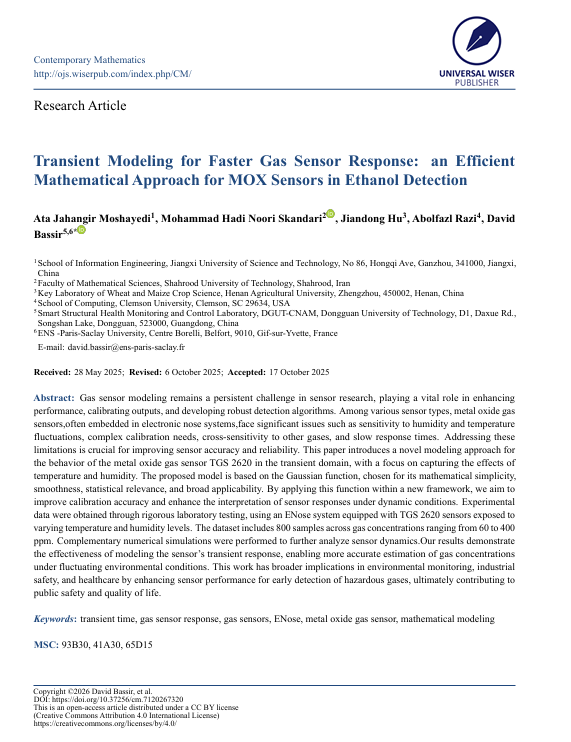
A multidisciplinary team—Dr. Ata Jahangir Moshayedi (RARL Lab, Jiangxi University of Science and Technology, China), Dr. Mohammad Hadi Noori Skandari (Shahrood University of Technology, Iran), Prof. Jiandong Hu (Key Laboratory of Wheat and Maize Crop Science, Henan Agricultural University, China), Dr. Abolfazl Razi (Clemson University, USA), and Prof. David Bassir (Smart Structural Health Monitoring and Control Laboratory, DGUT-CNAM, Dongguan University of Technology, China)—has published a new study titled “Transient Modeling for Faster Gas Sensor Response: An Efficient Mathematical Approach for MOX Sensors in Ethanol Detection.”
The paper introduces a novel mathematical model that significantly enhances both the responsiveness and accuracy of metal oxide (MOX) gas sensors, a widely used component in electronic nose (ENose) systems. Despite their popularity and low cost, MOX sensors have long suffered from limitations, including slow response times, strong sensitivity to humidity and temperature variations, and cross-interference from different gases.
In this groundbreaking work, the team proposes a Gaussian-based transient domain model specifically designed for the MOX sensor TGS 2620, commonly used for ethanol detection. This approach ensures smoother calibration and provides a more precise interpretation of sensor behavior under dynamic environmental conditions—especially when humidity or temperature fluctuates, conditions that often hinder traditional models.
The research is supported by extensive laboratory experiments, in which ENose systems equipped with TGS 2620 sensors were exposed to ethanol concentrations ranging from 60 to 400 ppm. The researchers collected 800 experimental samples under controlled variations in temperature and humidity, complemented by numerical simulations that validated the proposed transient model.
The results demonstrate that the new Gaussian-based model can more accurately estimate gas concentrations in rapidly changing environments, substantially improving the reliability and performance of gas sensing systems. These improvements have meaningful implications across several fields:
Environmental Monitoring: more accurate detection of air pollutants
Industrial Safety: faster and more reliable detection of hazardous gas leaks
Healthcare: improved sensor-based breath-analysis tools for diagnostics
This publication underscores the strength of international scientific collaboration, bringing together expertise from China, Iran, and the United States to address critical challenges in gas sensing technology. According to the authors, the proposed approach not only advances sensor modeling but also contributes to the development of safer industrial environments and improved quality of life worldwide.
The full study is available via DOI: 10.37256/cm.7120267320.